
The U.S. Bombed Iran’s Radar Eyes Over Hormuz. Iran Answered With Seven Missiles at Kuwait and Bahrain.
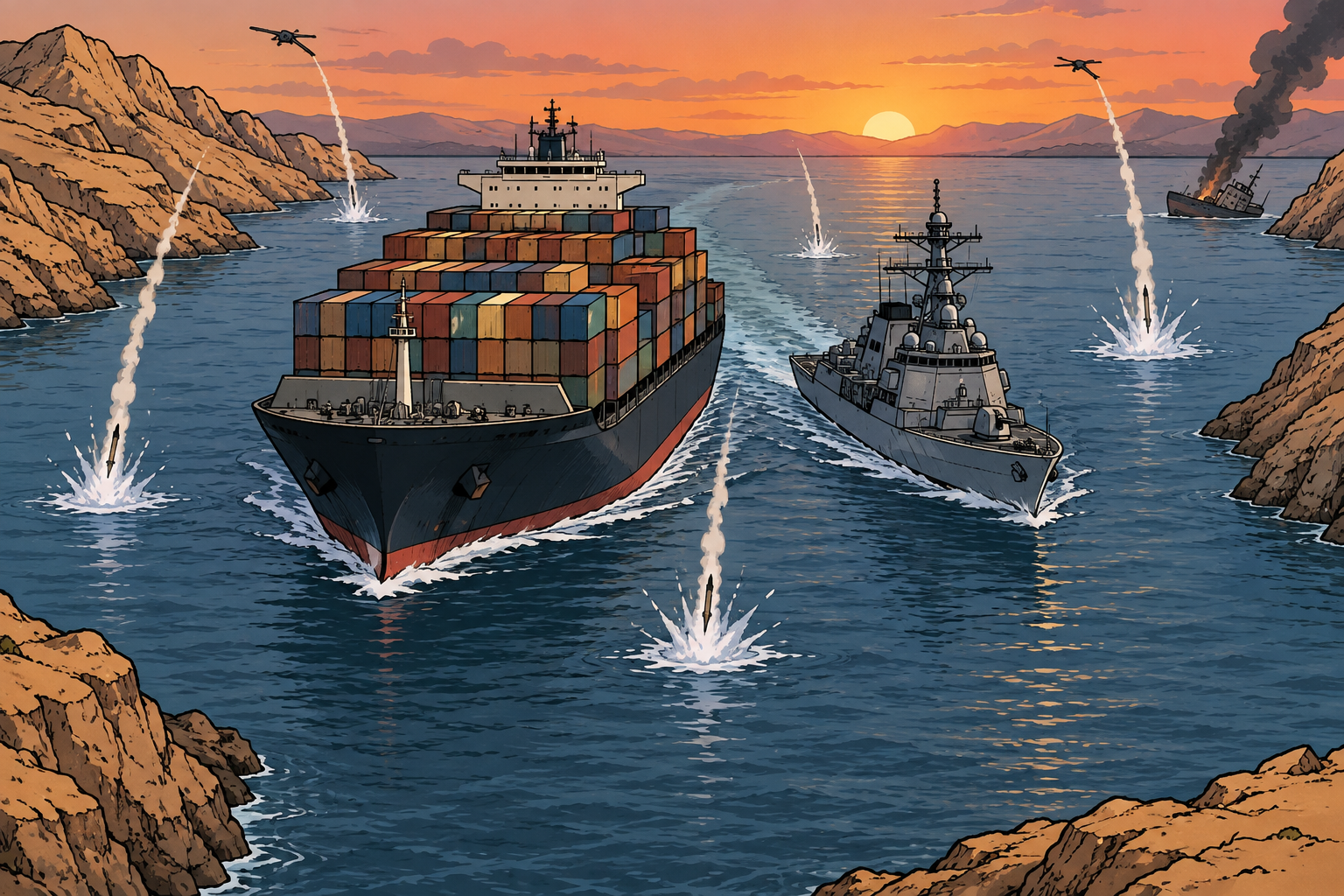
The latest escalation in the U.S.-Iran confrontation over the Strait of Hormuz turned from a naval standoff into open exchange of fire. According to U.S. Central Command, American forces shot down four Iranian “one-way attack” drones launched toward the strait, then struck Iranian coastal surveillance and air-defense radar sites at Goruk and on Qeshm Island — the IRGC’s primary eyes over the world’s most important oil chokepoint.
Iran retaliated by firing seven ballistic missiles toward Kuwait and Bahrain, both home to major U.S. military installations. CENTCOM said six were intercepted and the seventh “did not reach its intended target,” and reported no U.S. casualties. Tehran said it had struck “enemy bases” in response to U.S. strikes on the Iranian city of Sirik and Qeshm Island, and warned of the “complete closure” of the Strait of Hormuz if attacks continue.
This is the next turn after the June 5 naval blockade story we covered. What had been a maritime interdiction campaign has now produced U.S. offensive strikes inside Iranian territory and the first Iranian ballistic-missile attack on Gulf Arab states in this round. Details remain fluid; figures below are attributed to the parties making the claims.
- 7 missiles — Iran fired toward Kuwait and Bahrain; CENTCOM says 6 were intercepted and a 7th missed, with no U.S. casualties · Source: CENTCOM / The National
- 4 drones — Iranian one-way attack drones CENTCOM says it downed over the Strait of Hormuz before striking radar sites at Goruk and Qeshm Island · Source: CENTCOM
- $95 — approximate Brent crude per barrel as the exchange resumed; U.S. crude topped $100 in May during the same crisis · Source: ICE / CNBC
According to CENTCOM public releases, the strikes were framed as “self-defense” actions: U.S. forces first intercepted four Iranian one-way attack drones launched toward the Strait of Hormuz, which CENTCOM said “posed an immediate threat to regional maritime traffic,” then struck the Iranian radar and drone command-and-control sites that had been tracking shipping. The targeted sites sit at Goruk and on Qeshm Island, Iran’s largest island, which lies less than 20 kilometers from the Hormuz traffic-separation scheme.
Defense reporting on the operation describes Iranian air-defense and long-range radar assets among the targets — the kind of surveillance network the IRGC uses to monitor and threaten vessels entering the Persian Gulf. Those specific hardware claims come from open-source defense outlets rather than CENTCOM’s own release, and should be read as reported, not confirmed. What CENTCOM has stated on the record is that it struck “coastal surveillance radar sites” at Goruk and Qeshm in response to the drone threat.

Hours later, Iran fired seven ballistic missiles toward Kuwait and Bahrain — both of which host major U.S. forces, including the Fifth Fleet’s headquarters in Bahrain. Iran said the attack targeted “enemy bases” and was a direct response to the U.S. strikes on Sirik and Qeshm Island. CENTCOM reported that six of the seven missiles were intercepted and that the last failed to reach its target, with no U.S. personnel harmed.
Kuwait’s military said the explosions residents heard were air-defense interceptions. Bahrain condemned the strikes as “a flagrant violation of sovereignty” and said defending its territory was “a red line.” Saudi Arabia and Jordan also condemned Iran’s attack as a threat to regional security. According to The National, this was the second Iranian attack on the Gulf states since June 3, when a drone strike on Kuwait’s international airport killed one person and wounded 63.
Casualty figures in a live conflict are the easiest thing to get wrong, so we report only what each party has stated and attribute it. On the Gulf side, the verified human toll so far traces to the June 3 drone strike on Kuwait International Airport: one killed and 63 wounded, per Gulf authorities and wire services. For the June 6 missile barrage, CENTCOM and Bahrain both reported successful interceptions and no reported U.S. or allied deaths.
Iran has not released a verifiable count of casualties from the U.S. strikes on Goruk, Qeshm, and Sirik, and the United States has not published a battle-damage assessment beyond describing the radar and drone sites as struck. We are not assigning a number to the Iranian side; doing so on a fast-moving war story is exactly how misinformation spreads. When CENTCOM or a credible monitoring body issues figures, we will update.
“The attack drones posed an immediate threat to regional maritime traffic.”
U.S. Central Command · public release · June 2026

The Strait of Hormuz is the reason every one of these strikes reverberates through the global economy. According to the U.S. Energy Information Administration, roughly a fifth of the world’s petroleum liquids passes through the strait. With the exchange of fire resuming, Brent crude traded near $95 per barrel, after U.S. crude had already topped $100 during the May phase of the crisis, per CNBC and ICE pricing.
Iran’s explicit threat — that any continued U.S. attacks will trigger the “complete closure” of the strait — is what keeps a risk premium baked into the price. A full closure would be the largest single oil-supply disruption on record, and analysts have warned of triple-digit crude well beyond current levels if shipping stops entirely. For now, traffic is constrained rather than fully halted, and the market is pricing the difference between those two outcomes.
U.S. forces intercepted four Iranian one-way attack drones launched toward the Strait of Hormuz and struck Iranian coastal surveillance radar sites at Goruk and on Qeshm Island. Iran then fired seven ballistic missiles toward Kuwait and Bahrain; six were intercepted and the seventh did not reach its target. No U.S. casualties.
On the diplomatic track, Iran moved to shut the door. Iranian Foreign Minister Abbas Araghchi announced Tehran would halt indirect ceasefire talks conducted through intermediaries and keep pressing to close the Strait of Hormuz, accusing the Trump administration of ceasefire violations. Iranian state media framed the missile attacks on Kuwait and Bahrain as legitimate retaliation; the United States and Gulf governments rejected that framing as an attack on sovereign neighbors.
President Trump (R) has continued to assert that Iran’s capacity is badly degraded, stating that Tehran retains only roughly a fifth of its missile arsenal after months of U.S. operations. CENTCOM commander Adm. Brad Cooper told the Senate in May that more than 1,450 strikes had destroyed or damaged the bulk of Iran’s missile, drone, and naval industrial base — an assessment that frames Washington’s confidence in pressing the campaign.
President Donald Trump (R) — ordered and defended the strikes; says Iran retains only about a fifth of its missile arsenal.
Defense Secretary Pete Hegseth (R) — Pentagon chief overseeing the Hormuz campaign and the rules of engagement for U.S. forces in the strait.
Adm. Brad Cooper — CENTCOM commander; testified the U.S. has destroyed or damaged most of Iran’s missile, drone, and naval industrial base.
Abbas Araghchi — Iranian Foreign Minister; halted indirect talks and vowed to keep the Strait of Hormuz closed.
Kuwait & Bahrain — Gulf states targeted by Iran’s missiles; Bahrain called the strikes “a flagrant violation of sovereignty.” Saudi Arabia and Jordan also condemned the attack.
Iran fired missiles at Kuwait and Bahrain and we shot almost all of them down. Not a single American hurt. They have barely any missiles left. They should make a deal before they have nothing.
Paraphrased commentary · not a verbatim post
U.S. and partner forces defended against Iranian aggression in the Strait of Hormuz, downing attack drones and intercepting ballistic missiles fired at Kuwait and Bahrain. The United States will continue to protect its personnel, its partners, and freedom of navigation in the region.
The central question is whether the June 6 missile barrage is a one-off retaliation or the start of a sustained campaign against Gulf states. Iran’s threat to fully close the strait is the escalation everyone is watching: a real closure would draw in Gulf Arab militaries, spike oil past anything seen so far, and force a U.S. decision about whether to strike Iranian launch and missile infrastructure directly rather than the radar sites that support it.
For now, the pattern is a tightening tit-for-tat: an Iranian provocation, a U.S. self-defense strike, an Iranian retaliation, and a market that reprices on every headline. With indirect talks suspended on Tehran’s side, there is no active diplomatic channel publicly described to break the cycle. This story is developing, and the figures above reflect what the parties have claimed as of June 6, 2026; we will update as primary-source assessments are released.
Our forces in the Gulf are protected and ready. Iran attacked Kuwait and Bahrain and failed. We will defend American troops, our partners, and the free flow of commerce through the Strait of Hormuz. Peace through strength.
Paraphrased commentary · not a verbatim post

- 1.CENTCOM — 'U.S., Partner Forces Defend Against Aggressive Iranian Behavior,' Public Release, June 2026
- 2.CENTCOM — 'U.S. Defends, Disables Threats in Response to Iranian Aggression,' Public Release, June 2026
- 3.Al Jazeera — Live Blog: 'US strikes Iran's Qeshm; Tehran attacks Kuwait, Bahrain,' June 3, 2026
- 4.Al Jazeera — 'Iran, Kuwait, Bahrain hit: Is the war in the Gulf escalating again?' June 3, 2026
- 5.The National — 'Iran attacks Kuwait and Bahrain with seven ballistic missiles,' June 6, 2026
- 6.The Times of Israel — 'US says Iranian missile attacks on Kuwait and Bahrain failed, confirms striking Qeshm Island,' June 2026
- 7.NPR — 'U.S. bombs Iranian military sites, then downs missiles Tehran fired at troops in Kuwait,' June 1, 2026
- 8.The Hill — 'US bombs radar, drone sites in Iran,' June 2026
- 9.The Hill — 'Iran halts ceasefire talks with US, says it will keep Strait of Hormuz closed,' June 2026
- 10.CNBC — 'Iran stops negotiations with U.S., vows to completely block Strait of Hormuz,' June 1, 2026
- 11.CNBC — 'U.S. crude oil tops $100 again as hope fades for a U.S.-Iran peace deal,' May 2026
- 12.U.S. Energy Information Administration — World Oil Transit Chokepoints (Strait of Hormuz), updated 2026
- 13.CBS News — 'CENTCOM chief Adm. Brad Cooper tells senators Iran's hold on Strait of Hormuz has weakened,' May 2026
- 14.2026 Strait of Hormuz crisis — overview and timeline (Wikipedia, cross-referenced)