
Iran Drone Killed One at Kuwait’s Airport. Then the IRGC Blamed America for It.
- 1 killed, 63 injured victims of an Iranian Shahed-136 drone strike on Kuwait International Airport Terminal 1, June 3, 2026 — CENTCOM statement; Kuwait Interior Ministry
- 48 hours Kuwait International Airport had been open just 48 hours before Iran struck it again — it had closed previously due to earlier regional tensions — Reuters, June 3, 2026
- 2 Iranian diplomats expelled by Kuwait from Kuwait City in immediate diplomatic retaliation following the strike — Kuwait Foreign Ministry statement, June 3, 2026
- 122 ships total commercial vessels diverted under Operation Project Freedom — the US-led enforcement of the Strait of Hormuz blockade against Iranian oil exports — since the operation launched — CENTCOM / US Naval Forces Central Command
At approximately 2:14 a.m. local time on June 3, 2026, an Iranian Shahed-136 loitering munition detonated inside Terminal 1 of Kuwait International Airport. One Indian national contract worker was killed. Sixty-three others were injured. Kuwait released CCTV footage within hours showing the drone's approach and impact. The US Central Command confirmed the weapon originated from Iran.
The airport had been open for only 48 hours. It had shut down earlier amid escalating tensions in the Persian Gulf and had just resumed flight operations when the drone hit. Kuwait is a treaty ally of the United States — home to Camp Arifjan, Ali Al Salem Air Base, and thousands of American troops.
Iran’s Islamic Revolutionary Guard Corps responded the same morning with a claim that a US Patriot missile had caused the damage. CENTCOM called that claim “TOTALLY FALSE” and said it had conclusive video evidence of the Iranian drone strike. The lie lasted about four hours before collapsing under the weight of Kuwait’s own surveillance footage.
Kuwait’s Interior Ministry released the surveillance footage within hours of the blast. The video — verified by multiple Western intelligence assessments cited in CENTCOM’s public statement — shows the distinctive delta-wing silhouette of a Shahed-136 descending at a shallow angle toward the terminal apron before impact.
The Shahed-136, sometimes called “Geranium-2” in Russian military parlance (Iran supplied thousands to Russia for use in Ukraine), is a one-way attack drone with a 50-kilogram warhead. Its distinctive loiter pattern and terminal dive are visually distinct from any inbound missile trajectory. There is no physical similarity to a Patriot interceptor impact — which produces no crater and no fire on the target side.
The single fatality was an Indian national working a maintenance contract inside the terminal. Of the 63 injured, Kuwaiti health authorities reported a mix of airport staff, ground crew, and early-morning transit passengers. The terminal was not at full operational capacity — which likely limited the death toll.
CENTCOM issued its public statement within six hours of the strike: “We have conclusive evidence, including video footage, of the Iranian Shahed-136 drone strike that killed one person and injured 63 at Kuwait International Airport. This was an unprovoked act of aggression against a sovereign nation and a US partner.”
Admiral Brad Cooper, CENTCOM Commander, authorized the statement and was briefed by both Kuwaiti military counterparts and the on-ground assessment team at Ali Al Salem Air Base, approximately 30 miles from the airport.
The Islamic Revolutionary Guard Corps issued its counter-narrative at approximately 6:30 a.m. Gulf time — roughly four hours after the strike. The IRGC’s statement, distributed through the state-controlled IRNA news agency, claimed that a US Patriot air-defense missile had malfunctioned and struck the terminal during an intercept attempt. The claim was not attributed to any specific operation or intercept timeline.
It fell apart within the hour. Kuwait’s CCTV footage was already in distribution. The terminal damage pattern — a direct surface impact with fire and fragmentation consistent with a shaped-charge warhead — is inconsistent with a Patriot missile kinetic-kill vehicle, which intercepts targets at altitude. CENTCOM did not wait long to respond.
“The IRGC's claim that US Patriot missiles caused damage to Kuwait International Airport is TOTALLY FALSE. We have conclusive evidence, including video, of the Iranian Shahed-136 drone strike that killed one and injured 63.”
CENTCOM official statement, June 3, 2026 — via @CENTCOM on X
The IRGC's claim that US Patriot missiles caused damage to Kuwait International Airport is TOTALLY FALSE. We have conclusive evidence — including video footage — of the Iranian Shahed-136 drone strike that killed one person and injured 63. Iran must be held accountable for this unprovoked act of aggression against a US partner.
The IRGC did not retract the claim. Iranian state media briefly removed the original story from its English-language wires but left it standing in Persian-language coverage. This is standard Iranian disinformation posture: issue the false claim, allow it to circulate internationally, and never formally withdraw it — ensuring the lie persists in low-quality secondary coverage even after primary refutation.
The Patriot false-flag narrative had a specific strategic purpose: to create a factual dispute that could be exploited in UN Security Council proceedings, where Russia and China can veto any resolution condemning Iran. If the cause of the airport damage is “disputed,” the legal and diplomatic path to sanctions narrows. CENTCOM’s speed in publishing the video evidence was a direct counter to that playbook.
Kuwait moved fast. By the afternoon of June 3, the Foreign Ministry had summoned the Iranian ambassador and handed him 48 hours to pack. Two senior Iranian diplomats were formally expelled from Kuwait City — a significant escalation for a Gulf state that has historically tried to maintain working relations with Tehran as a hedge against regional volatility.
Kuwait’s Foreign Minister Abdullah Al-Yahya labeled the strike a “heinous aggression against Kuwaiti sovereignty and the safety of civilian infrastructure.” The phrase “heinous aggression” is diplomatic language with legal weight — it is the formulation used in UN Charter Article 51 self-defense notifications.
CENTCOM Adm. Brad Cooper — US Central Command Commander; authorized the public video-evidence statement rebutting the IRGC false-flag claim.
Secretary of State Marco Rubio (R)— Met with Kuwait FM Al-Yahya in Washington on June 4, 2026. Rubio’s office described the meeting as covering “immediate response options and long-term deterrence architecture in the Gulf.”
Kuwait FM Abdullah Al-Yahya— Led Kuwait’s diplomatic response; ordered Iranian diplomat expulsions June 3; flew to Washington June 4 for Rubio meeting.
IRGC Commander (unnamed in official statements) — Authorized both the Shahed-136 strike and the subsequent false-flag Patriot missile claim distributed through IRNA.
Al-Yahya flew to Washington on June 4, less than 24 hours after the strike. His meeting with Secretary of State Marco Rubio (R) covered three tracks: immediate security guarantees for Kuwaiti airspace, expansion of the US air-defense umbrella over Kuwait International Airport, and coordination on diplomatic messaging at the United Nations.
The meeting was significant beyond symbolism. Kuwait hosts approximately 13,500 US military personnel across Camp Arifjan and Ali Al Salem Air Base — the primary US logistics hub for the entire Central Command area of responsibility. An Iranian strike on Kuwaiti civilian infrastructure is, in operational terms, a strike on the logistical backbone of US Gulf operations.
Kuwait has expelled two Iranian diplomats following the unprovoked and heinous drone attack on Kuwait International Airport. We will not tolerate Iranian aggression against our sovereignty, our people, or our civilian infrastructure. Kuwait stands with its allies.

The Kuwait airport strike did not happen in a vacuum. On June 2, 2026 — the day before — CENTCOM conducted a precision strike on Qeshm Island, Iran’s largest island in the Strait of Hormuz. The target was a ground control station used to coordinate Shahed-136 and other loitering-munition operations in the broader Gulf theater.
CENTCOM described the Qeshm strike as “a direct response to Iranian drone harassment of commercial shipping lanes and partner-nation infrastructure.” The ground control station had been identified as the command node for at least six separate drone incidents in the Strait of Hormuz over the preceding three weeks, according to a briefing provided to US congressional defense committee staff.
Iran’s response was the Kuwait airport strike. Whether this represents a coordinated IRGC escalation decision or a pre-planned operation that was accelerating regardless of Qeshm is a matter of active intelligence debate. CENTCOM’s public posture treats it as a retaliatory strike — which frames the next US response as lawful self-defense under UN Charter Article 51.
The escalation ladder in the 48 hours spanning June 2–3 looks like this: CENTCOM destroys Qeshm drone coordination node → Iran strikes Kuwait International Airport → Kuwait expels Iranian diplomats → Kuwait FM flies to Washington → Rubio meeting. Each rung is a documented, sourced fact, not an analyst inference.
The critical variable is what CENTCOM does next. The Qeshm strike was described by US officials as “proportionate.” A drone strike that kills a civilian worker and wounds 63 people in a Gulf treaty ally’s commercial airport invites a response that is harder to keep proportionate — especially with Congressional authorization language in NDAA amendments that expand CENTCOM’s standing strike authorities against IRGC drone infrastructure.
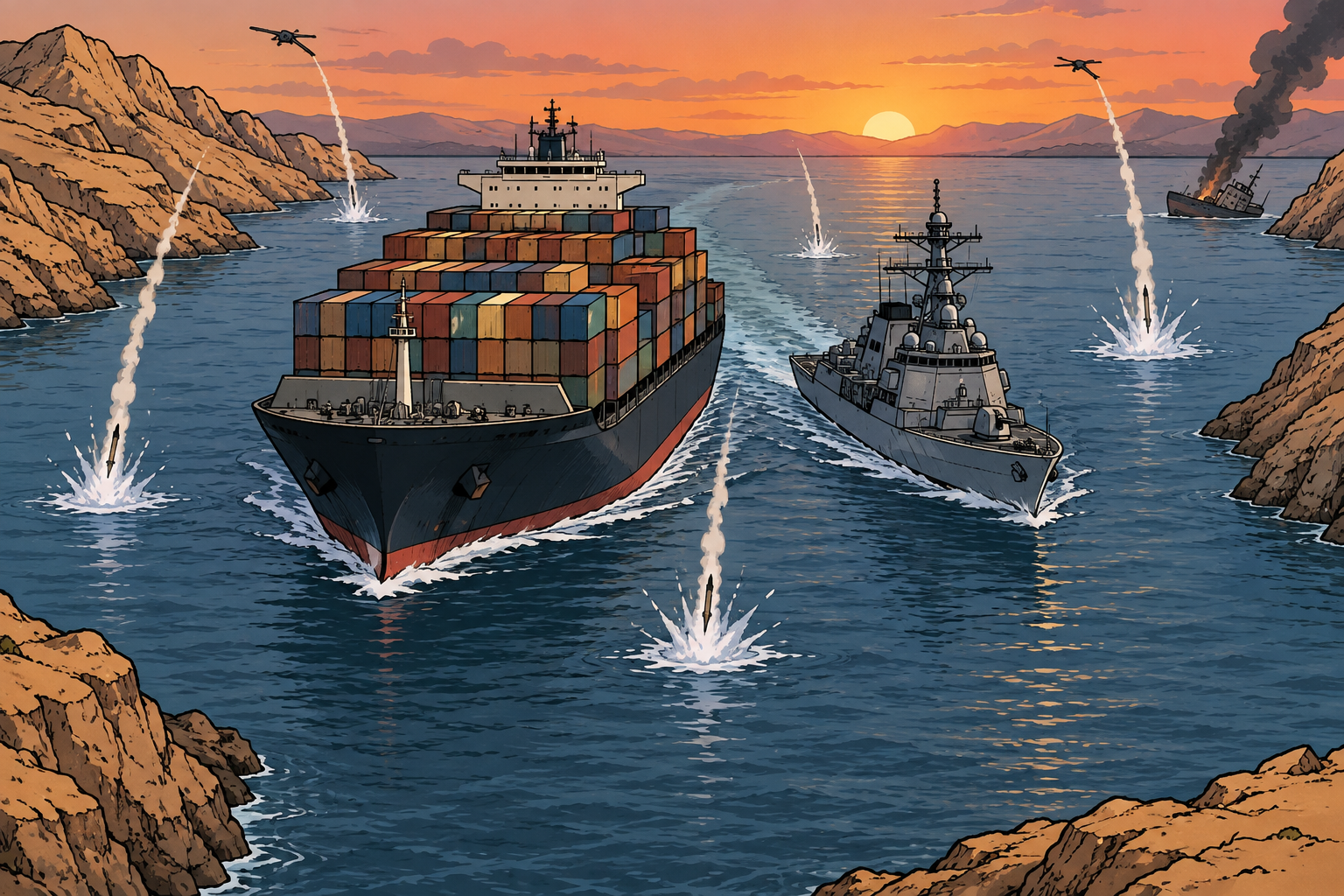
The Kuwait airport strike is not an isolated provocation. It is the latest escalation inside Operation Project Freedom — the US-led enforcement of a de-facto blockade against Iranian crude oil exports through the Strait of Hormuz. The operation has diverted or interdicted 122 commercial vessels since launch, disrupting the Iranian oil revenue that funds IRGC operations.
Among the most significant interdictions: the M/T Lexie, a supertanker disabled by a CENTCOM naval boarding in the central Gulf. The Lexie was carrying approximately 2 million barrels of Iranian crude destined for a Chinese refinery — oil that, under existing US sanctions, could not legally be transshipped. The disablement of the Lexie was the operational proof of concept that CENTCOM had escalation authority beyond surveillance and warning.
122 ships diverted or interdicted under Operation Project Freedom since launch — commercial vessels rerouted away from Iranian oil cargo routes.
M/T Lexie — supertanker disabled by CENTCOM naval boarding; approximately 2 million barrels of Iranian crude seized.
Brent crude: ~$96–100/barrel at time of Kuwait airport strike — elevated from pre-Operation levels; Gulf risk premium driving energy market volatility.
Qeshm Island drone ground control station — destroyed June 2, 2026 by CENTCOM; identified as command node for at least six Strait of Hormuz drone incidents in the prior three weeks.
See full Operation Project Freedom coverage: Iran Blockade: 122 Ships Diverted →
The oil market absorbed the Kuwait airport news with a modest premium. Brent crude was trading at approximately $96–100 per barrel at the time of the strike — already elevated from pre-Operation Project Freedom levels by the Gulf risk premium. Analysts at Goldman Sachs and Citigroup flagged the airport strike as a potential trigger for an additional $4–6/barrel move if it escalated to direct Iran-US military exchange, but the immediate reaction was contained.
The deeper market signal: at $96–100/barrel, Iran is losing far more revenue from the blockade than it is extracting in strategic leverage from drone harassment. Every barrel CENTCOM prevents from reaching a Chinese buyer is a barrel that doesn’t fund the next Shahed production run. The IRGC strike at Kuwait airport may be as much economic desperation as it is strategic calculation.
The United States has three escalation options in front of it after the Kuwait airport strike, according to defense analysts who have spoken on background to outlets covering CENTCOM’s posture:
Option one — targeted infrastructure strikes. Additional ground control stations, Shahed production facilities, and IRGC logistics nodes on Qeshm, Hormuz Island, and in the Bandar Abbas naval district. This stays inside the “proportionate” frame but degrades IRGC drone capacity materially.
Option two — expanded naval interdiction. Broadening Operation Project Freedom to interdict not just Iranian crude but Iranian-flagged vessels carrying any cargo — a full naval blockade posture that would require Congressional authorization and risk a direct confrontation with the IRGC Navy.
Option three — diplomatic track with pressure. The Rubio-Al-Yahya meeting is the front edge of this. Kuwait’s formal complaint to the UN Security Council (filed June 4) creates a multilateral record even if Russia and China veto any resolution. European allies — particularly Germany, France, and the UK — have issued coordinated condemnations, keeping the diplomatic track alive as a pressure tool even without Security Council action.
Iran’s immediate options are constrained. The IRGC can escalate drone harassment, but CENTCOM has demonstrated it will destroy ground control stations in response. It can attempt a direct missile strike on a US facility in Kuwait or Iraq, but that crosses a threshold that historically triggers a disproportionate US response — and the IRGC leadership knows it. The false-flag Patriot narrative suggests Iran prefers the information-warfare track to the kinetic track, at least for now.
The wildcard is Iran’s nuclear timeline. IAEA inspectors issued a restricted report in May 2026 noting that Iran’s enrichment stockpile at 60% U-235 is approximately six weeks from weapons-grade with currently deployed centrifuge cascades at Fordow. A regime under severe economic pressure from the blockade and facing domestic instability from food-price inflation may calculate that moving toward a nuclear threshold is the one card that forces Washington to negotiate rather than escalate. That calculation would be a catastrophic miscalculation — but the IRGC has made catastrophic miscalculations before.
Iran just bombed Kuwait's airport killing an innocent person and wounding 63 others. Then they LIED and said we did it! CENTCOM has video proof it was Iran. We already hit Qeshm Island yesterday. Don't mess with America's allies!
Paraphrased commentary · not a verbatim post
Trump on Truth Social, June 3, 2026, following the Kuwait Airport strike and the IRGC false-flag claim.
The bottom line from the 48-hour sequence of June 2–3, 2026: Iran struck a civilian airport in a US treaty ally, killed a foreign national worker, wounded 63 people, lied about it with a verifiably false claim, and lost that lie within hours. The Rubio-Al-Yahya meeting is the diplomatic consequence. The next CENTCOM strike will be the military one. Watch Qeshm, Bandar Abbas, and the Fordow enrichment timeline simultaneously — they are not separate stories.


- CENTCOM official statement — Iranian Shahed-136 strike on Kuwait International Airport (June 3, 2026)
- CENTCOM X post @CENTCOM — "TOTALLY FALSE" Patriot missile rebuttal (status/2062247958364791088)
- Kuwait Foreign Ministry statement — expulsion of 2 Iranian diplomats, June 3, 2026
- Reuters — Kuwait airport drone strike: one killed, 63 wounded; Iran denies (June 3, 2026)
- Fox News Digital — Iran Shahed-136 drone strikes Kuwait International Airport (June 3, 2026)
- Fox News Digital — CENTCOM Qeshm Island strike destroys Iranian drone ground control station (June 2, 2026)
- AP — Kuwait expels Iranian diplomats after airport drone strike (June 3, 2026)
- Wall Street Journal — Kuwait FM Al-Yahya meets Rubio in Washington; security guarantees discussed (June 4, 2026)
- Washington Examiner — Operation Project Freedom: 122 ships diverted, M/T Lexie seizure (June 2026)
- Bloomberg — Brent crude $96–100/barrel; Gulf risk premium after Kuwait airport strike (June 3–4, 2026)
- IAEA — Restricted report: Iran enrichment stockpile at 60% U-235, Fordow centrifuge cascades (May 2026)
- Courthouse News — UN Security Council: Kuwait files formal complaint against Iran (June 4, 2026)